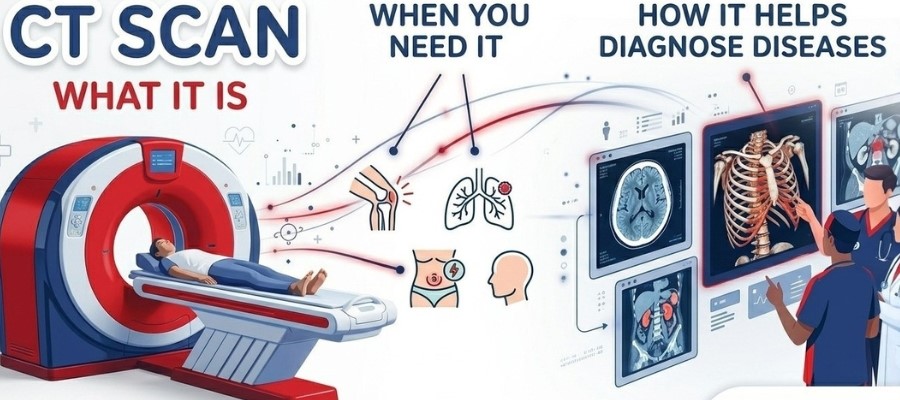
Imagine yourself going to a doctor complaining about a continuous, stabbing pain in your stomach or saying that a small injury during a sport keeps hurting. The doctor hears you talking about the pain, but says that to really understand what is going on in your body, seeing and performing a physical examination is not enough. The doctor recommends a CT scan in Udaipur to provide a comprehensive view of your internal organs.
Your thoughts could go wild with questions. Do they resemble an X-ray? Is radiation exposure safe? Does it hurt, and how long does it last in that big machine? Knowing this frequently used yet highly efficient diagnostic tool will help turn a confusing medical proposal into a simple step toward recovery. This blog will explain how this type of imaging works, its role in modern medicine, and what you should do before the meeting.
What Is a CT Scan and How Does It Work?
A Computed Tomography (CT) scan is a highly advanced diagnostic tool that combines a series of X-ray images captured from different angles throughout your body. A computer thereafter processes these layered images, "slices" to make cross-sectional images of the bones, blood vessels, and soft tissues. Whereas a standard flat X-ray is like viewing the front cover of a book, a CT scan enables doctors to examine the "pages" of your body one by one.
How it works:
-
The patient is positioned on a table that moves through a round scanner.
-
The device takes multiple X-ray images from different angles.
-
A computer combines these pictures together to create detailed 3D images.
CT scans are a fast and non-invasive diagnostic tool for evaluating a variety of medical conditions.
When Do Doctors Recommend a CT Scan?
Physicians rely on this technology chiefly because it is fast and precise. Although MRI scans are better suited for certain soft tissues, a CT scan test is often the first choice in cases of trauma or sudden pain, because it can give results within only a few minutes.
Doctors order this scan for the following purposes:
-
Diagnosing Bone and Muscle Issues: A CT scan can identify complex bone fractures or tumours that may not be visible on a normal X-ray.
-
Detecting Internal Injuries and Bleeding: Quickly finding internal hemorrhaging or organ damage following a mishap.
-
Disease Localization: Determining the precise location of a tumour, infection, or blood clot.
-
Monitoring Treatment: Evaluating whether a patient is responding well to therapies such as chemotherapy or radiation.
-
Guided Procedures: Assisting doctors to perform biopsies or operations by providing a real-time "map" of the area.
For example, a CT scan for the brain may be advised in cases of head injury, stroke, unexplained seizures, or persistent severe headaches.
What Diseases Can a CT Scan Detect?
A CT scan imaging test can help diagnose a wide range of conditions across different parts of the body.
It is commonly used to detect:
1. Head and Neurological Health
A CT scan for Brain, also called a brain CT, is one of the most common methods used to find the cause of severe, sudden headaches, dizziness, or the symptoms of stroke. It is quite accurate in detecting:
-
Brain hemorrhages or blood clots.
-
Brain tumours or abscesses.
-
Skull fractures after head trauma.
2. Chest and Abdominal Issues
For the torso, CT scanning is the gold standard for evaluating the lungs, heart, and digestive organs. It aids in detecting:
-
Pneumonia or lung cancer.
-
Pulmonary embolisms (blood clots in the lungs).
-
Kidney stones and gallstones.
-
Appendicitis or inflammatory bowel diseases (IBD)
3. Cardiovascular Health
Techniques like CT coronary angiography are advanced CT imaging tests that can visualize coronary arteries without surgery, enabling the diagnosis of arterial blockages or narrowing and potentially reducing the need for invasive diagnostic methods in some cases.
Thus, it offers a non-invasive method for evaluating heart health and the risk of heart attack.
Is a CT Scan Safe for Patients?
Generally speaking, when a CT scan is used appropriately, the radiation exposure is low enough to be considered safe.
Key safety points:
-
Uses a controlled amount of radiation
-
Benefits usually outweigh the risks.
-
Not recommended frequently unless necessary
On the other hand, it is still good to be aware of the following:
-
Pregnancy: Pregnant women should always inform their doctor as radiation might pose a risk to a developing fetus.
-
Patients with allergies: Some CT scans require a special dye (contrast), so inform a technician if you have ever had an allergic reaction to iodine.
-
Kidney function: If contrast dye is used, patients with kidney problems may require additional monitoring to confirm that the dye is properly eliminated from their bodies.
-
Repeated scans should be avoided unless medically required.
How Long Does a CT Scan Take?
A CT Scan Imaging Test is a quick and efficient procedure.
Typical duration:
-
Scan time: 5-10 minutes
-
Total process: 15-30 minutes (including preparation)
If contrast dye is used, it may take slightly longer.
Most patients can resume normal activities immediately after the scan.
Preparation: Do You Need Fasting Before a CT Scan Test?
Preparation for a CT scan depends entirely on the part of the body being scanned.
1. You may need to avoid eating 4-6 hours before if:
-
Contrast dye is used.
-
Abdominal scans are planned.
2. For Non-Contrast Scans:
Fasting is usually not required. You can usually eat and drink normally before your appointment.
3. Clothing:
Wear comfortable clothing. You may also need to remove metal objects, such as jewelry, belts, or eyeglasses, as they can interfere with the imaging.
4. Medications:
Continue taking your usual medications unless your doctor specifically tells you otherwise.
Note: Stay hydrated unless instructed otherwise.
CT Scan Cost in Udaipur
Costs vary across diagnostic centres in Udaipur depending on services and technology.
Factors affecting cost:
-
Body part being scanned.
-
Use of contrast dye
-
Type of diagnostic centre
-
Technology used
CT Scan Diagnostic Centre in Udaipur: What to Look For
Choosing the right CT Scan Diagnostic Centre Udaipur is important for getting accurate results.
Consider the following:
-
Advanced imaging technology
-
Qualified radiologists
-
Hygiene and safety standards
-
Clear reporting and timely results
A reliable centre ensures accurate diagnosis and a smooth patient experience.
Benefits of CT Scan Imaging Test
CT scans are now an important diagnostic tool in healthcare for their precision and fast processing. Major advantages:
-
Provides detailed internal images due to high resolution imaging.
-
3D visualization enables physicians to view body parts from different perspectives.
-
Quick and efficient meaning ideal for emergency diagnosis.
-
Can reveal injuries, infections, tumours, and problems with blood vessels.
-
Assists in biopsies, surgeries, and treatment planning
-
Measures healing and alterations of illness over time.
-
Tracks recovery and disease changes over time.
Conclusion
A CT scan in Udaipur is a very effective method for diagnosing diseases by scanning the body.
Knowing how it works and its reasons for use can help reduce anxiety and ensure you are better prepared for the process.
Selecting a right CT Scan Diagnostic Centre Udaipur is equally crucial for getting accurate images and a hassle-free experience.
Medicentre provides up-to-date CT scan facilities that prioritize accuracy and patient comfort, enabling people to make well-informed health decisions.
FAQs
1. What is a CT scan, and how does it work?
A CT scan is a highly detailed radiographic examination that combines X-rays and computer technology to generate sectional images of the body.
The scanner takes multiple images from various directions and blends them to produce flat or three-dimensional images that enable a physician to investigate a patient's lungs, bones, and soft tissues with greater accuracy than with conventional X-rays.
2. When do doctors recommend a CT scan?
When doctors need very detailed internal images to diagnose a condition, they usually recommend a CT scan. These conditions include head injuries, chest infections, abdominal pain, tumours, or internal bleeding. Besides diagnosis, CT scans are also used to monitor a patient's response to treatment and to assist with procedures such as biopsies or surgeries by providing more accurate guidance.
3. Is a CT scan safe for patients?
When performed properly under medical supervision, CT scans present no or minimal risk to one's health. Patients are exposed to a relatively small and safe amount of radiation during the procedure; the potential health benefits of an accurate diagnosis generally outweigh the risk. Nevertheless, special measures are required for certain groups, such as pregnant women, children, patients on repeat CT scans and also those undergoing contrast medium administration.
4. How long does a CT scan take?
A CT scan is a brief procedure, with the actual scan lasting only 5 to 10 minutes on average. The whole process, including preparation and positioning, may take 15 to 30 minutes. If a contrast dye is used, the time required may be slightly longer, depending on the type of scan.
5. Do you need fasting before a CT scan?
Generally, fasting is not a requirement if you are undergoing a CT scan, but it might be necessary, especially when contrast dye is used, such as, in the case of abdominal imaging. In these conditions, patients are typically instructed not to eat anything for 4 to 6 hours before the test and to follow the doctor's directions.
6. What diseases can a CT scan detect?
A CT scan can help detect a wide range of diseases, such as brain disorders, lung infections, cardiac problems, tumours, internal traumas, and digestive system diseases. Moreover, it is an effective technique for detecting blood clots, fractures, and organ abnormalities, making it a comprehensive diagnostic tool for pinpointing ailments accurately and at an early stage.
Categories
LATEST from Blog
- CT Scan: What It Is, When You Need It & How It Helps Diagnose Diseases
- Prioritizing Your Well-being: A Guide to Preventive Health Checkups in Udaipur
- Automated Microbiology Testing in Udaipur with VITEK Technology
- How to Check Heart Blockage at Home & Cardiac Tests in Udaipur
- X-Ray for Lungs: Tuberculosis, Pneumonia In Udaipur